

PCOS can make ovulation unpredictable, so bleeding patterns do not always tell you what is happening inside the ovaries. By tracking your cycles and understanding the hormone and metabolic clues, you can recognise when evaluation is needed and choose the right next step for period control or pregnancy planning.
Key takeaways
- Track cycles and seek assessment when periods are absent or widely spaced.
- PCOS involves ovulation, androgen and insulin-related changes—not ovarian cysts alone.
- A healthy-looking weight does not rule out PCOS or metabolic risk.
- Irregular ovulation can make conception harder without meaning infertility.
Why PCOS Can Make Periods Long, Scattered or Absent
PCOS ovulation can become infrequent because follicles do not mature and release an egg regularly. Without ovulation, progesterone is not produced on its usual schedule, so the uterine lining remains exposed to estrogen for longer.
A long menstrual cycle may then last more than 35 days, while skipped ovulation can produce no bleeding for weeks or months.
Bleeding after a long gap is not always a normal period. An unstable uterine lining can shed unpredictably, causing spotting, prolonged bleeding or a heavier episode. Repeated long gaps increase the risk of endometrial hyperplasia, or excessive thickening of the lining.
Ask for medical evaluation if your cycle pattern includes:
- Fewer than eight periods in one year
- Cycles longer than 35 days
- Any gap of more than 90 days
- Bleeding that lasts more than seven days, becomes unusually heavy or occurs between periods
- A sudden change from your usual pattern, including missed periods when pregnancy is possible
Record the first day of full bleeding, the last bleeding day, spotting, flow and pain in an app or calendar. A period that appears regular does not always prove that ovulation occurred, so clinicians may assess ovulation separately when pregnancy is a goal.
Do not rely on routine ultrasound screening alone if you have no symptoms; a clinician can decide whether cycle regulation or scheduled progestogen is needed to protect the uterine lining.
The PCOS Hormone Pattern Is More Than Ovarian Cysts
Insulin resistance can drive the PCOS pattern even at a lower body weight. The pancreas releases extra insulin to keep blood glucose stable, and high insulin can encourage the ovaries to produce more androgens while disrupting normal ovulation.
- Androgen excess can cause increased facial or body hair, acne, or scalp hair thinning. Symptoms can matter even when a routine testosterone result is normal; a mildly high result needs interpretation alongside symptoms, the testing method, and other possible causes.
- Follicle development can stall before one follicle becomes dominant and releases an egg. Without regular ovulation, periods become widely spaced or absent, and conception becomes harder because the timing of egg release is unpredictable.
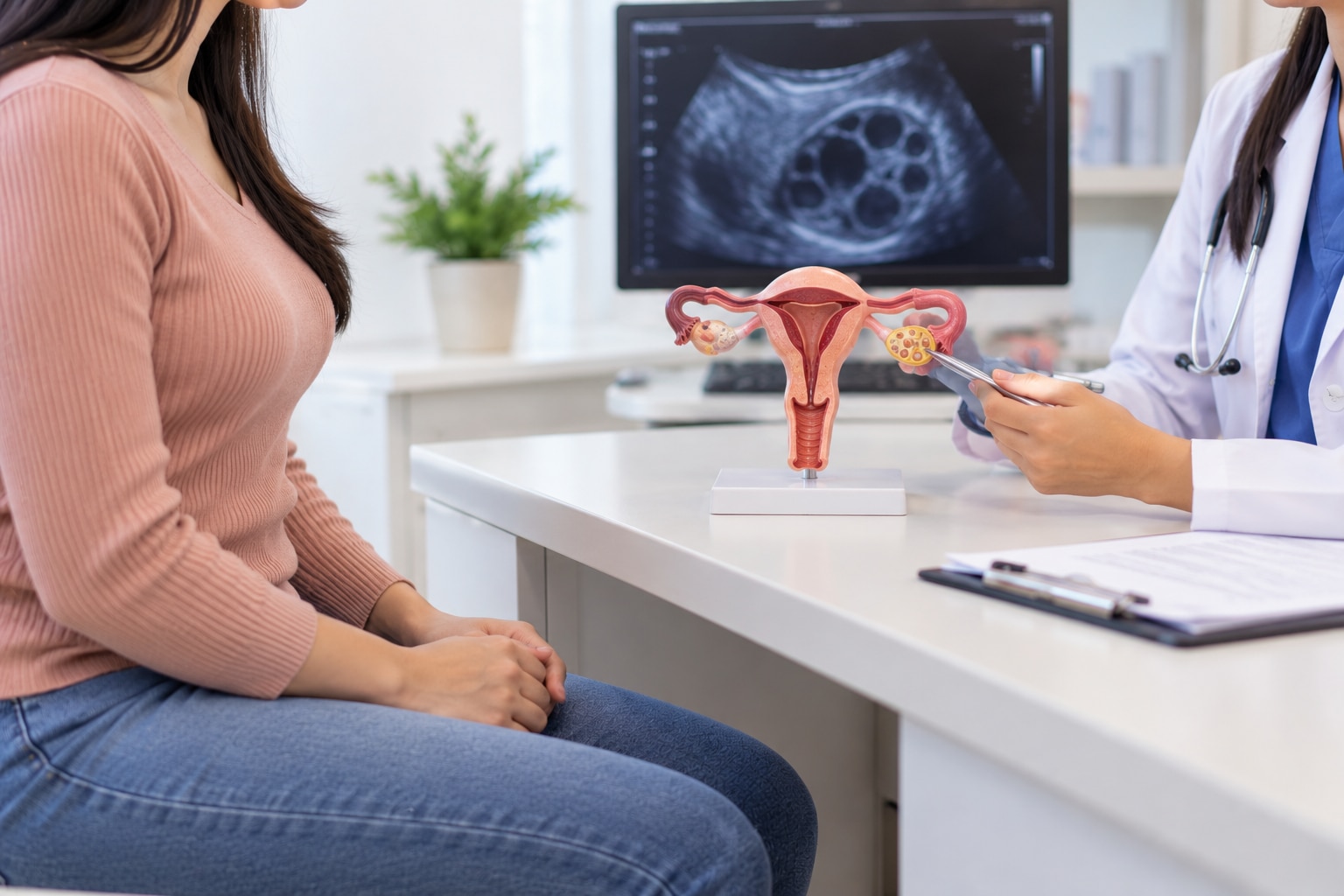
- Polycystic ovarian morphology means an ovary contains many small, immature follicles or has increased ovarian volume. These are not dangerous cysts that need removal; they reflect follicles that did not complete normal development.
Ovarian cysts are not required for an adult PCOS diagnosis. After other causes are excluded, the 2023 international guideline uses two of three findings: hyperandrogenism, ovulatory dysfunction, or polycystic ovarian morphology on ultrasound or an elevated anti-Müllerian hormone level.
An ultrasound appearance alone does not prove PCOS, and many people with that appearance have no syndrome. During adolescence, ultrasound and anti-Müllerian hormone are not recommended for diagnosis because normal puberty can temporarily resemble PCOS.
Why Weight Alone Cannot Show Your PCOS or Metabolic Risk
Insulin resistance can raise insulin levels, encourage fat storage around the abdomen, increase hunger, and make weight management harder. Androgen excess and disrupted sleep can add to these effects. PCOS weight changes do not follow one pattern: some people gain weight, some remain weight-stable, and some have insulin resistance at a smaller body size.
Weight loss is not a prerequisite for PCOS treatment or pregnancy.
Track these risk clues instead of judging health from body weight alone:
- A larger waist can indicate more abdominal fat, which is linked with insulin resistance even when BMI is not high.
- Raised blood pressure increases cardiovascular risk and may occur without noticeable symptoms.
- Abnormal glucose or lipid results can reveal metabolic problems before you feel unwell.
| Measure | What it reveals | Why it matters |
|---|---|---|
| Scale weight or BMI | Body size and change over time | Cannot diagnose PCOS or rule out insulin resistance |
| Waist measurement | Abdominal fat distribution | Adds metabolic information that BMI misses |
| Blood pressure | Cardiovascular strain | High readings need repeat checks and clinical review |
| HbA1c glucose testing | Average blood glucose over about three months | Detects prediabetes or diabetes risk; a clinician may add an oral glucose tolerance test |
| Lipid profile | Triglycerides, HDL, LDL and total cholesterol | Identifies cholesterol patterns linked with cardiometabolic risk |
Use the full picture: waist measurement, blood pressure, HbA1c glucose testing, lipid results, symptoms, and family history. A normal scale reading does not cancel risk, and an elevated reading does not prove PCOS.
PCOS Fertility: Irregular Ovulation Does Not Mean Infertility
Inconsistent ovulation reduces the number of chances to conceive and makes fertile days difficult to predict; it does not make pregnancy impossible. An egg may be released after a long gap, and ovulation can occur before the next period arrives.
PCOS fertility treatment targets this missed or delayed ovulation, with letrozole recommended as the first-line medicine for anovulatory infertility when no other factor is identified. Metformin may help some metabolic or treatment plans, but it is not a universal fertility drug.
Ovulation tracking with irregular cycles works best when you combine clues rather than rely on a calendar:
- Record the first day and length of every bleed.
- Use cervical mucus changes as a possible sign of approaching ovulation.
- Use basal body temperature to confirm a sustained temperature rise after ovulation.
- Discuss urine luteinising hormone tests with a clinician; PCOS can produce misleading positive results.
- Ask about a blood progesterone test timed to the suspected ovulation, rather than automatically ordering it on “day 21.”
Contraception remains necessary if pregnancy is not wanted. Ovulation can happen unpredictably during a month without bleeding, and sperm can survive for several days in the reproductive tract.
Hormonal contraception may prevent pregnancy while also reducing heavy or erratic bleeding and protecting the uterine lining; a clinician should choose it after reviewing blood pressure, migraine with aura, smoking, clotting history and other risks.
A Practical Fertility and Pregnancy Assessment Pathway
Seek a fertility assessment after 12 months of regular unprotected sex if you are under 35, or after six months if you are 35 or older.
Book it sooner when periods are absent or widely spaced, ovulation is uncertain, there is a history of pelvic surgery or endometriosis, or your partner has a possible fertility concern.
1. Start with both partners, not only the person with PCOS. A semen analysis checks sperm count, movement and shape; an abnormal result needs repeat testing because one sample does not explain every cycle.
2. Confirm whether ovulation is occurring. Blood tests for ovulation usually include progesterone timed to the expected post-ovulation phase, although irregular cycles require clinician-guided timing. Thyroid-stimulating hormone, prolactin and other hormone tests can identify conditions that resemble or worsen ovulatory dysfunction.
3. Use an ultrasound to examine the uterus, ovaries and endometrial lining. Follicle monitoring can show whether a follicle grows and releases an egg; a single scan cannot prove that ovulation happened.
4. Treat the finding rather than the label. When PCOS causes anovulatory infertility and no other factor is found, letrozole is the recommended first-line ovulation medicine. Clomiphene, metformin, gonadotropins or assisted reproduction fit selected situations, not every patient.
Before conception, review blood pressure, glucose risk and current medicines. Once pregnant, arrange early assessment because PCOS is linked with higher risks of gestational diabetes and hypertensive disorders. Dr. Jagruti Kadam 8048033934 can help coordinate cycle assessment, testing and preconception planning in Thane.
Related services
PCOS Treatment ₹1000 Dr. Jagruti Kadam offers specialized PCOS treatment focused on long-term hormonal balance and symptom management. View service → |
Hormonal Imbalance Treatment ₹1000 Dr. Jagruti Kadam offers expert care for hormonal imbalance with a patient-centered approach tailored to each woman’s needs. View service → |
Frequently asked questions
Why can PCOS make periods long, scattered or absent?
PCOS can prevent follicles from maturing and releasing an egg regularly. Without ovulation, progesterone is not produced on its usual schedule, so the uterine lining remains exposed to estrogen for longer.
Is PCOS only a condition involving ovarian cysts?
No. PCOS involves a pattern that can include irregular ovulation, higher androgen activity and insulin-related changes. Ovarian appearance is only one part of assessment.
Can you have PCOS or metabolic risk at any weight?
Yes. Weight alone cannot confirm or exclude PCOS or metabolic risk. A clinician combines menstrual history, symptoms, examination and appropriate blood tests.
Does irregular ovulation mean infertility?
No. Irregular ovulation can reduce the number of opportunities to conceive, but it does not mean pregnancy is impossible. Fertility assessment can identify ovulation and other factors affecting conception.
Related services
Menstrual Disorders Management Menstrual Disorders Management ₹1000 Dr. Jagruti Kadam offers expert management of menstrual disorders with a personalized and compassionate approach. View service → |
Infertility Treatment ₹1000 Dr. Jagruti Kadam provides comprehensive infertility treatment with a patient-centered and evidence-based approach. View service → |
Fibroids Treatment ₹1000 Dr. Jagruti Kadam provides advanced fibroids treatment with a personalized and patient-focused approach. View service → |