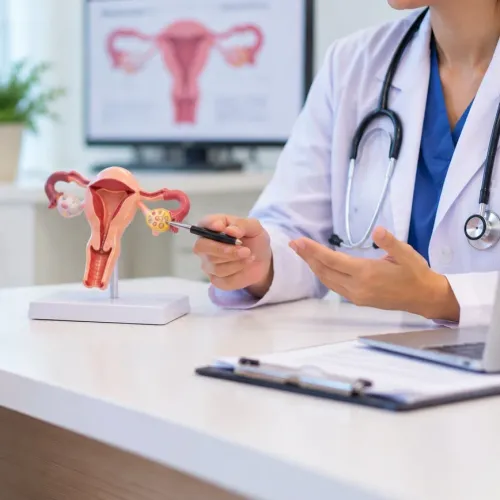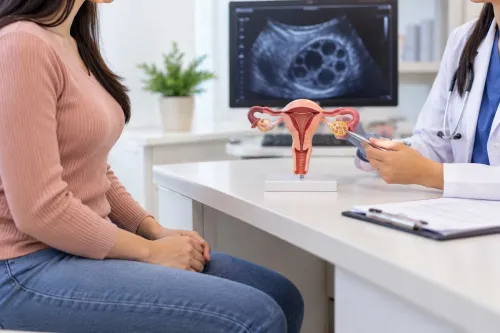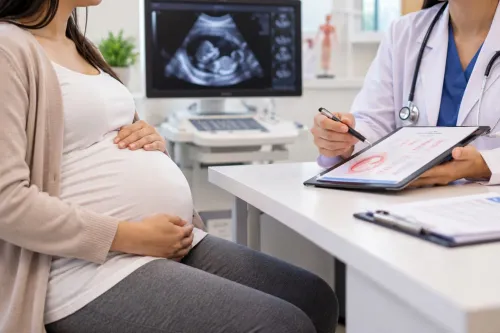


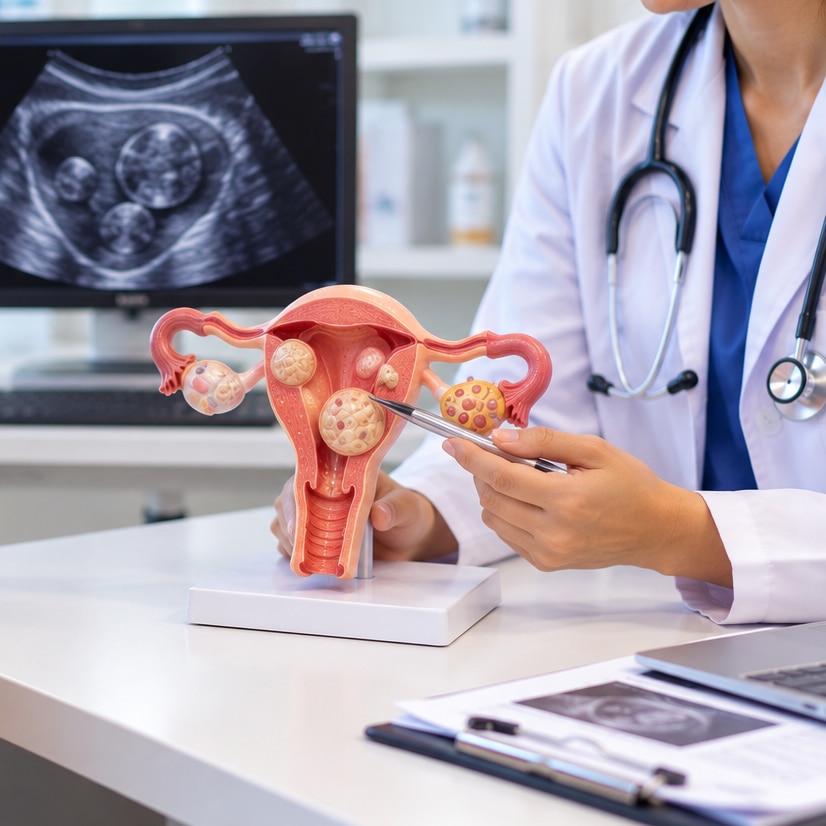
A fibroid’s position inside, within or outside the uterus often matters more than its size when bleeding, pressure or fertility concerns develop. You will learn how to read symptom patterns, understand an ultrasound report, distinguish association from proof in reproductive problems, and identify which evaluations and treatment trade-offs deserve a discussion with a gynecologist.
Key takeaways
- A small submucosal fibroid can cause prolonged, heavy menstrual bleeding.
- Pressure symptoms depend on fibroid location, not size alone.
- Fibroids can affect conception and pregnancy differently for each person.
- Ultrasound helps confirm fibroid size, number and location.
Why a Small Cavity Fibroid Can Cause Very Heavy Periods
A small fibroid that grows into the uterine cavity can cause very heavy bleeding by disrupting the lining and normal uterine contraction, which helps stop menstrual flow. This is why submucosal fibroid heavy bleeding is more strongly linked with prolonged or heavy periods than fibroids on the outside.
Intramural fibroids sit within the muscular uterine wall. Intramural fibroid periods can become heavier or longer when the lesion enlarges the wall or affects uterine contraction. Subserosal fibroids grow toward the outer surface, so subserosal fibroid bleeding is less common unless the lesion also distorts the cavity.
Symptoms do not reliably match fibroid size or number. One small cavity fibroid can cause more bleeding than a much larger outer-surface fibroid.
Seek assessment for these warning patterns:
- Soaking a pad or tampon in under 1–2 hours, or bleeding for longer than 7 days
- Passing clots larger than a ₹10 coin or spotting between periods
- Developing fatigue, dizziness, palpitations, breathlessness or reduced exercise tolerance
These symptoms can signal iron-deficiency anaemia from repeated blood loss, not anaemia directly caused by the fibroid. A clinician can check a complete blood count and ferritin. Seek urgent care for fainting, severe breathlessness, chest pain or bleeding that will not slow.
How Fibroids Create Pressure—and Why Size Alone Misleads
A fibroid’s location can matter more than its diameter: a large outer-surface fibroid or one deep in the uterine muscle can create fibroid pelvic pressure without causing heavy bleeding. It may press on the bladder, causing frequent urination or difficulty emptying it, and on the bowel, causing constipation or rectal pressure.
Other bulk symptoms include fibroid abdominal enlargement, lower-back pain, pelvic aching and pain during sex.
| Fibroid position or pattern | Main effect | Why symptoms differ |
|---|---|---|
| Subserosal, on the outer surface | Pressure, urinary or bowel symptoms | It pushes against nearby organs rather than directly distorting the cavity |
| Large intramural, within the uterine wall | Pressure, aching, back pain and enlargement | Muscle-wall growth reduces space as it expands |
| Several smaller fibroids | Combined pressure or enlargement | Their total occupied space can be substantial |
| Small submucosal, inside or toward the cavity | Heavy or prolonged bleeding | Cavity distortion affects the endometrial surface and bleeding pattern |
The phrase fibroids frequent urination constipation describes a pressure pattern, not a diagnosis. Pressure usually builds gradually as the uterus or fibroid enlarges. Fibroid degeneration sudden pain is different: severe pain can occur when a fibroid outgrows its blood supply and tissue breaks down.
Pressure, bleeding and pain also occur with adenomyosis, endometriosis, ovarian cysts, endometrial polyps, pregnancy-related bleeding, and hormonal or ovulatory causes. Symptoms alone cannot identify a fibroid; examination and appropriate testing are needed.
What Fibroids Can Mean for Conception and Pregnancy
A fibroid does not usually prevent pregnancy: most people with fibroids are not infertile. The clearest reproductive concern is a submucosal or other cavity-distorting fibroid, which can change the endometrial cavity and interfere with sperm movement or implantation; this is where fibroids implantation problems have the strongest clinical link.
Finding a fibroid during an infertility evaluation does not prove it caused infertility. A fibroid present during a miscarriage does not prove it caused the loss; age, ovulation, sperm factors, chromosome changes and other uterine conditions can contribute. “Fibroids and infertility” describes an association, not an automatic diagnosis.
Fibroids can be associated with higher pregnancy risks, but these outcomes are not certain.
| Feature | What it means | Reproductive significance |
|---|---|---|
| Cavity-distorting fibroid | Changes the uterine cavity, often from a submucosal position | Strongest link with reduced fertility and implantation difficulty |
| Non-cavity-distorting fibroid | Does not alter the cavity’s shape | Finding one does not prove it caused infertility |
| Fibroid during pregnancy | May be linked with miscarriage, preterm birth, abnormal fetal position, placental problems, caesarean delivery or postpartum haemorrhage | Fibroids miscarriage risk and other risks are increased associations, not predictions |
Discuss pregnancy plans before choosing myomectomy, uterine artery embolization or another uterine-sparing procedure. Myomectomy preserves the uterus, while embolization can relieve symptoms but has less certain future fertility and pregnancy outcomes; removing every fibroid is not automatically beneficial.
How Doctors Confirm Whether Fibroids Explain the Symptoms
A clinician does not attribute every heavy period or pressure symptom to a fibroid seen on a scan. The investigation connects your symptoms, examination, blood tests and imaging.
1. Describe cycle length, bleeding days, clots, flooding, spotting, pain timing, bowel or urinary symptoms, and pressure. Report pregnancy possibility, previous pregnancies or losses, medicines such as anticoagulants or hormonal contraception, and any personal or family bleeding disorder.
2. Expect a pelvic examination and blood tests. A complete blood count checks for anaemia, while ferritin checks iron stores; “complete blood count ferritin fibroids” is a useful search phrase, but your clinician interprets results with your symptoms.
3. Pelvic ultrasound is usually the first imaging test. For fibroid ultrasound report meaning, check the number of lesions, each measurement in centimetres, its location, and whether it is submucosal, intramural or subserosal. The key question is whether it distorts the uterine cavity.
4. Saline-infusion sonography places sterile saline in the uterus to outline a cavity lesion more clearly. Hysteroscopy uses a camera to inspect the cavity directly and can sometimes remove an intracavitary fibroid or polyp.
5. MRI maps multiple or uncertain fibroids before a procedure, showing depth, location and nearby structures. This is where hysteroscopy and MRI for fibroids serve different purposes.
Adenomyosis, endometriosis, polyps, ovarian cysts, pregnancy-related bleeding, ovulatory disorders, medication effects, endometrial disease and rarely malignancy require separate testing. Age, risk factors, bleeding pattern and findings determine whether endometrial sampling is needed.
Choosing Relief When Bleeding, Pressure or Fertility Goals Collide
Medication fits bleeding or pain when you want relief without removing the fibroid; it usually does less for pressure from bulk. This fibroid medication versus surgery decision depends on symptom severity, fibroid location and myomectomy fertility priorities.
| Option | Best fit | Important limit |
|---|---|---|
| Tranexamic acid, NSAIDs or hormonal options | Heavy bleeding, cramps or cycle control | Controls symptoms; does not remove the fibroid |
| GnRH agonists or oral GnRH antagonist regimens with add-back therapy | Temporary shrinkage or improved haemoglobin before surgery | Hot flashes, bone effects or regrowth after treatment; not a permanent cure |
| Uterine artery embolization | Bleeding and pressure relief without removing the uterus | Uterine artery embolization pregnancy and fertility outcomes are less certain than after myomectomy |
A hysteroscopic myomectomy suits a fibroid projecting into the uterine cavity. Laparoscopic or robotic myomectomy may suit selected smaller or accessible fibroids, while open surgery is considered when size, depth or number makes minimally invasive removal unsuitable. Myomectomy preserves the uterus but carries adhesion, bleeding and recurrence risks.
Hysterectomy removes the uterus, ends the ability to carry a pregnancy and eliminates fibroid recurrence; this hysterectomy fibroid recurrence difference makes it definitive, not fertility-preserving. Rapid growth alone does not prove cancer, but postmenopausal bleeding, persistent pain, atypical imaging or sudden severe symptoms need prompt review.
A gynecological assessment with Dr. Jagruti Kadam 8048033934 in Thane can help match treatment to bleeding, pressure and future pregnancy plans.
Related service
Fibroids Treatment ₹1000 Dr. Jagruti Kadam provides advanced fibroids treatment with a personalized and patient-focused approach. View service → |
Frequently asked questions
Why can a small cavity fibroid cause very heavy periods?
A submucosal fibroid grows into the uterine cavity, where it disrupts the lining and uterine contractions that help control menstrual bleeding.
Do larger fibroids always cause more pelvic pressure?
No. Location matters as much as size. A fibroid near the bladder, bowel or pelvic nerves can cause pressure with less overall growth.
Can fibroids affect conception or pregnancy?
Fibroids can affect conception or pregnancy when they distort the uterine cavity, alter implantation conditions or occupy space as the uterus grows.
How do doctors confirm that fibroids cause symptoms?
Doctors compare your bleeding, pressure or fertility history with a pelvic examination and imaging, usually an ultrasound that shows fibroid number, size and location.
How are treatment choices made when symptoms and fertility goals overlap?
Treatment depends on bleeding severity, pressure, fibroid location and whether you are trying to conceive. Doctors may discuss medicines, procedures or surgery.