

Laparoscopy is not automatically the best answer to pelvic pain, bleeding, infertility concerns or an ovarian mass. The recommendation depends on what your examination and scans show, whether treatment has worked, your fertility plans, anaesthesia risk and which surgical route offers the safest result.
Key takeaways
- Persistent symptoms and treatable pelvic findings can justify laparoscopy.
- Diagnostic laparoscopy identifies disease; operative laparoscopy treats selected conditions during the same procedure.
- Your surgeon weighs recovery benefits against anaesthesia, adhesions, bleeding, and conversion risks.
- Ask what happens if laparoscopy becomes unsafe or requires open surgery.
What findings make laparoscopy worth considering?
Laparoscopy becomes worth considering when symptoms persist, tests reveal a treatable pelvic cause, or observation no longer offers a safe answer. Persistent pelvic pain or heavy bleeding despite appropriate medical treatment raises the threshold for direct inspection, especially when examination or ultrasound shows disease that medication cannot address.
1. An ovarian cyst that persists, grows, causes pain, or has solid areas, thick walls, internal blood flow, or other concerning features may need surgical assessment. A small, simple, uncomplicated cyst that is shrinking can usually be monitored with repeat ultrasound.
2. Suspected endometriosis, adhesions, or infertility linked to possible tubal or pelvic disease can justify laparoscopy when results would change treatment. An examination or ultrasound finding that cannot be characterised confidently may also require direct inspection.
3. Pain or bleeding with possible ectopic pregnancy requires an urgent pregnancy test before treatment decisions. A positive test, concerning ultrasound, or worsening symptoms needs prompt assessment; laparoscopy may be part of treatment rather than routine investigation.
MRI may clarify deep endometriosis, show fibroid location, or characterise a complex mass before surgery. A mass suspicious for cancer needs gynaecological oncology planning rather than routine laparoscopy.
A laparoscopic surgeon does not recommend minimally invasive gynaecological surgery simply because it is newer or uses smaller incisions. The expected benefit is weighed against medication, observation, hysteroscopy, uterine artery embolisation, another operation, and fertility effects.
Laparoscopy can create adhesions or affect ovarian tissue, so the decision must fit your symptoms, findings, health, and pregnancy plans.
What can diagnostic and operative laparoscopy do?
Diagnostic laparoscopy uses a camera passed through a small abdominal incision to inspect the uterus, ovaries, fallopian tubes, peritoneum and pelvis. It looks for a cause of pain, infertility, bleeding or an abnormal scan; it does not automatically authorize treatment.
| Diagnostic laparoscopy | Operative laparoscopy |
|---|---|
| Looking for disease or the source of symptoms | Treating a finding during the same operation |
| Inspection, photographs and possible biopsy | Treatment when findings, safety and consent allow it |
| The surgeon may remove a specimen for laboratory examination | Options include ovarian-cyst removal or drainage, ectopic pregnancy surgery, endometriosis surgery, adhesion division, selected prolapse repairs, fallopian-tube removal, myomectomy or hysterectomy |
A surgeon may combine both approaches when the planned consent covers likely findings. For example, visible endometriosis may be excised or ablated, or a damaged tube may be removed during ectopic pregnancy treatment.
A planned diagnostic procedure may still need a separate operation. That happens when treatment would be unsafe, a mass appears malignant, bleeding cannot be controlled, or the required operation is better performed through the vagina or an abdominal incision.
A suspicious mass also requires careful specimen handling and assessment by a gynaecological oncology team rather than routine removal.
How does the surgeon choose laparoscopy over other surgical routes?
The surgeon chooses the route that reaches the disease safely while preserving your goals, not simply the route with the smallest incisions.
| Approach | What it involves | Best suited to |
|---|---|---|
| Hysteroscopy | Instruments pass through the vagina and cervix | A submucosal fibroid or uterine polyp; not an ovarian cyst or external endometriosis |
| Laparoscopic or robotic-assisted surgery | Abdominal camera and instruments, with robotic instruments controlled by the surgeon | Ovarian cysts, endometriosis, selected myomectomy and hysterectomy |
| Vaginal hysterectomy | The uterus is removed through the vagina | Generally preferred for benign disease when access is feasible |
| Open abdominal surgery | A larger abdominal incision | A very large uterus, distorted anatomy or extensive disease |
For fibroids, the choices may include medication, hysteroscopic removal, uterine artery embolisation, laparoscopic myomectomy or hysterectomy. Size, number and location determine whether a fibroid projects into the uterine cavity, can be removed through small abdominal incisions, or requires a different operation. Laparoscopic hysterectomy is an alternative when vaginal hysterectomy is unsuitable.
The recommendation also changes with:
- Prior abdominal operations, adhesions and body habitus, which affect entry and visibility
- Age, fertility plans and whether the ovaries should be conserved
- Heart and lung health, which affects anaesthesia and carbon-dioxide insufflation
- The surgeon’s experience with the exact procedure
Preserving the uterus does not guarantee preserved fertility. Laparoscopic myomectomy or pelvic surgery can create adhesions, while ovarian surgery can remove healthy ovarian tissue and affect ovarian reserve. Discuss that trade-off before choosing surgery.
When is laparoscopy unsafe or likely to change into open surgery?
Unstable bleeding requires rapid control, not a planned laparoscopic route. Severe cardiopulmonary disease can make carbon-dioxide insufflation or general anaesthesia hazardous. Other laparoscopy contraindications or caution factors include dense adhesions, very large uterine masses, distorted anatomy and situations where open surgery already offers safer access.
| Finding | Safer planning question | Possible route |
|---|---|---|
| Unstable bleeding or major injury risk | Can bleeding be controlled quickly? | Open surgery |
| Severe heart or lung disease | Can anaesthesia and abdominal pressure be tolerated? | Individual anaesthetic assessment or non-laparoscopic route |
| Dense adhesions or very large mass | Can organs be separated and the specimen removed safely? | Laparoscopy with planned conversion or open surgery |
| Suspicious mass | Can cancer be removed intact and properly staged? | Gynaecological oncology plan |
Previous abdominal surgery, obesity, or heart and lung disease do not automatically rule out laparoscopy. They change trocar-entry planning, anaesthetic risk, operating time and conversion risk, so the surgeon must assess the whole patient.
A mass that appears benign may suit laparoscopy. Suspicious solid areas, abnormal blood flow, ascites or rapid growth require review by a gynaecological oncology team. Tissue fragmentation and power morcellation can spread an unrecognised cancer; the FDA warns against power morcellators for many patients with known or suspected malignancy.
Conversion to open surgery is a deliberate safety decision when visibility, bleeding control or organ separation becomes inadequate—not automatic failure. Discuss bleeding, infection, bowel, bladder, ureter or blood-vessel injury, clots, anaesthetic complications and further surgery.
What should you expect before and during the operation?
Your laparoscopy preparation usually starts with a pelvic examination and a review of why surgery is preferable to medication, observation or another route. The assessment may include:
- Ultrasound, with MRI when it could clarify deep endometriosis, fibroid location or a complex mass
- A pregnancy test, especially for pain or bleeding
- Blood tests, such as a blood count and tests chosen for the planned operation
- Review of medicines, allergies and anticoagulants; do not stop an anticoagulant without instructions
- Discussion of fertility plans, uterine preservation and ovarian conservation
Written consent should name the alternatives, likely complications, specimen testing and the possibility of conversion to open surgery. Ask how bleeding, bowel, bladder, ureter or blood-vessel injury, clots, anaesthetic complications and further surgery would be managed.
| Option | What it means | Why it matters |
|---|---|---|
| Laparoscopic hysterectomy with ovarian conservation | Removes the uterus but leaves the ovaries | Does not automatically cause immediate surgical menopause |
| Fallopian-tube removal with ovarian conservation | Removes the tubes while retaining the ovaries | A separate option that may be discussed for risk reduction |
| Ovary removal | Removes one or both ovaries | Considered for particular ovarian disease, cancer risk or other reasons |
Follow the anaesthesia team’s fasting instructions exactly. Arrange an adult to take you home and stay with you after day surgery when required.
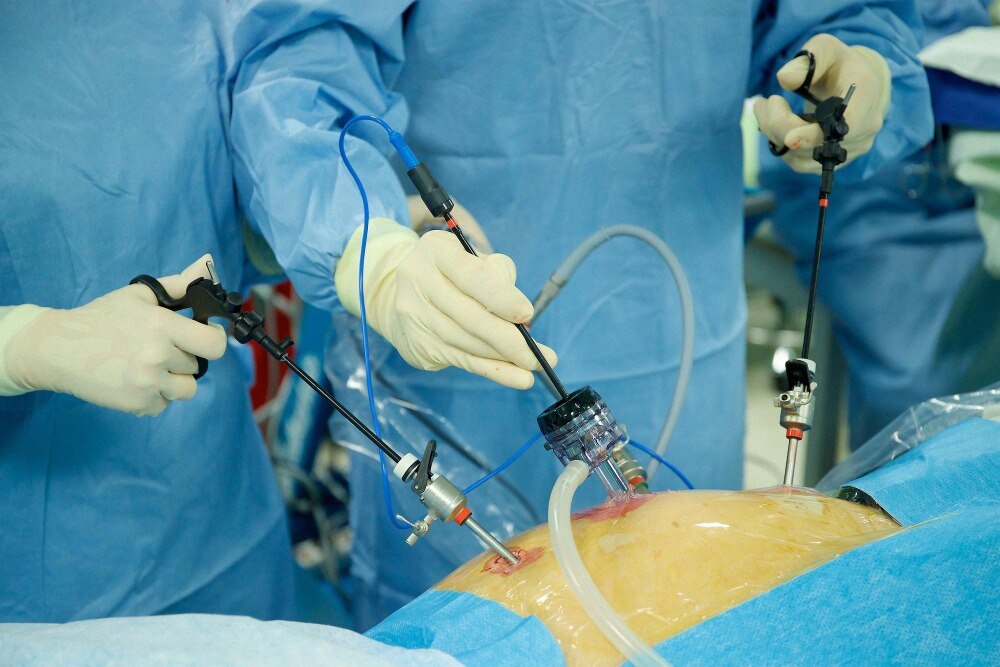
During the operation, general anaesthesia is used. Carbon dioxide insufflation gently expands the abdomen; a camera and instruments enter through small incisions. The surgeon removes tissue through an incision, the vagina or a protected extraction method, then closes the sites.
Laparoscopic surgery recovery is often shorter than after open surgery, but a long or technically difficult procedure can reduce that advantage. In Thane, Dr. Jagruti Kadam 8048033934 can discuss experience with the exact operation, expected conversion rate, alternatives and who would manage a major complication.
Related service
Laparoscopic Gynaecologist ₹1000 Dr. Jagruti Kadam is a skilled laparoscopic gynecologist offering advanced minimally invasive surgical care for various women’s health conditions. View service → |
Frequently asked questions
What findings make laparoscopy worth considering?
Laparoscopy becomes worth considering when persistent pelvic pain or heavy bleeding continues despite appropriate treatment, or when examination or ultrasound suggests a pelvic condition that medication cannot address. The decision depends on whether direct inspection could find a treatable cause.
What can diagnostic and operative laparoscopy do?
Diagnostic laparoscopy lets the surgeon inspect the pelvis and identify conditions such as endometriosis, adhesions, ovarian cysts, or other abnormalities. Operative laparoscopy uses small instruments to treat selected findings during the same operation, such as removing a cyst, dividing adhesions, or treating endometriosis.
How does the surgeon choose laparoscopy over other surgical routes?
The surgeon compares laparoscopy with vaginal, hysteroscopic, or open abdominal surgery based on the suspected condition, its size and location, previous operations, adhesions, medical history, and the treatment required. Laparoscopy is chosen when it offers a suitable route with less abdominal disruption than open surgery.
When is laparoscopy unsafe or likely to change into open surgery?
The surgeon may avoid or stop laparoscopy when severe adhesions, uncontrolled bleeding, limited visibility, unexpected disease, or anaesthesia and medical risks make keyhole surgery unsafe. The consent discussion should include the possibility of converting to open abdominal surgery.
What should you expect before and during the operation?
Before surgery, expect a medical review, examination, relevant imaging or tests, medication instructions, fasting guidance, consent, and a discussion of recovery and conversion to open surgery. During the operation, you receive general anaesthesia, small abdominal incisions are made, carbon dioxide is used to create working space, and a camera and instruments are inserted.